Published: February 2014 · Updated: July 2026 · by arch. Dan Dumitriu · FD.STIL
The three lights of a lighting plan
Every successful lighting plan is made of three layers. Each has its role, and rooms differ only in the proportion between them. You'll find each room's recipe in the room guides; here are the three layers, one by one.

Ambient lighting
Also called ambient light, it creates a uniform, comfortable level of light across the room — the layer that stands in for daylight and the foundation of the lighting plan.
It is provided by chandeliers, ceiling lights, sconces, spotlights, concealed light (coves) or, outdoors, by lanterns.
Task lighting
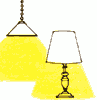
It accompanies activities: reading, cooking, paperwork, study, games, hobbies. It comes from spotlights, concealed light, pendants or portable lamps.
Its rule: no glare and no shadows, with intensity high enough not to tire the eyes.
Accent light
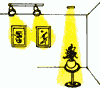
It adds drama and visual interest: it highlights paintings, wall textures, curtains or the landscape outside. It comes from spotlights, concealed light or sconces.
Its rule: at the focal point, accent light should be at least three times stronger than the general light around it.
The right pieces
Search the collections · 900 models, 14 styles
